.png)
Original Part Number
Every part has its own number, which is always unique, and this allows us to determine which vehicle and equipment version the part will fit, and conversely which ones it will not fit, or whether it can be used as a replacement for another part. The number may be on a paper label or stamped directly onto the component. This means that if you have a damaged or non-functional part, you can use this number to identify and purchase a new one with confidence that it will fit your vehicle. For this reason, we try to list the original part number for all products advertised in our e-shop, and you can also search by this number on our website. Of course, it may happen that the number label is torn off or is no longer readable. In such a case, you can contact us by email and we will try to identify the part based on other information provided, for example by VIN, sample, or photo.
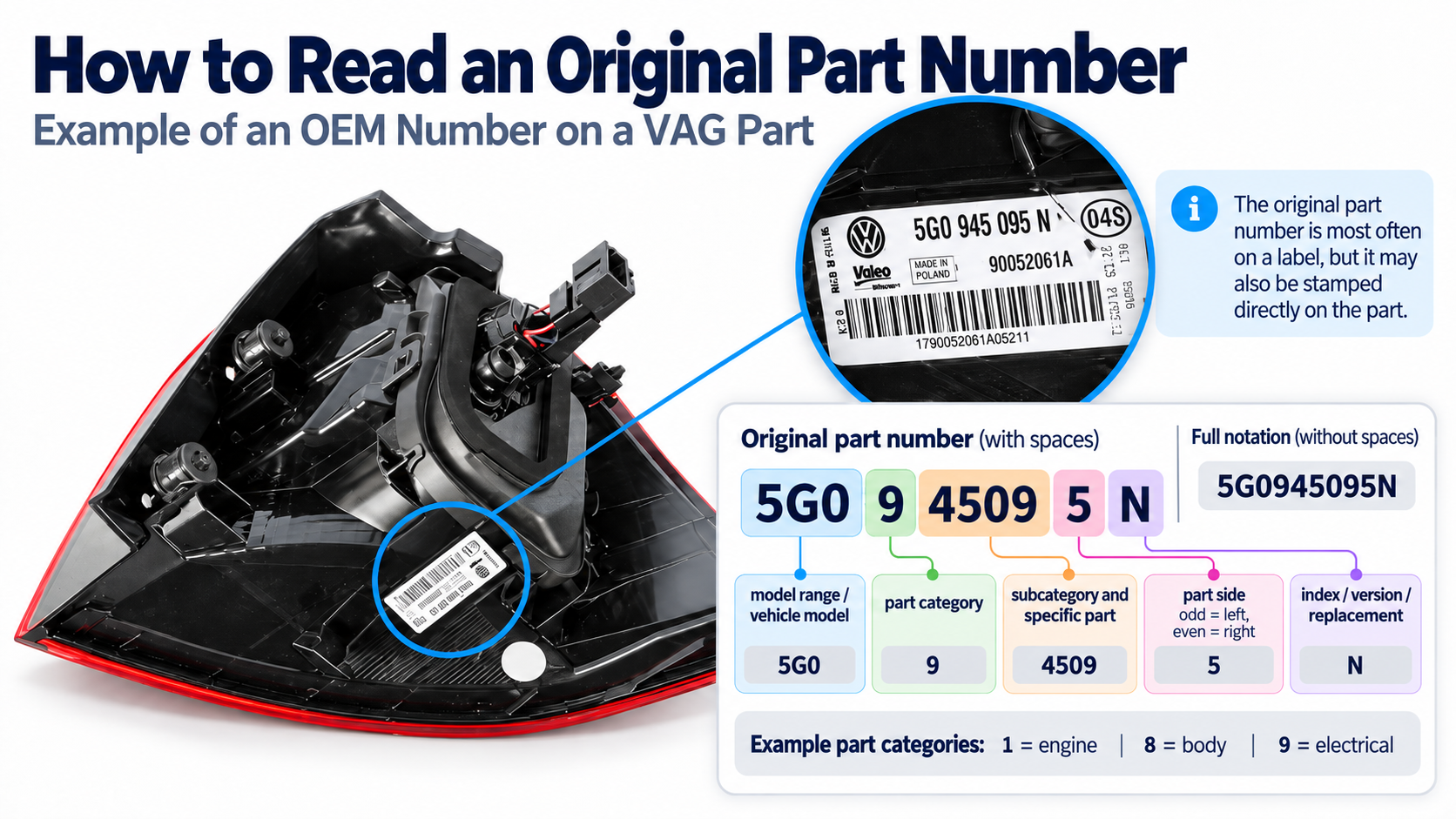
What does an original part number look like?
The original number can be found either on a paper label, see the image, or stamped directly onto the part. It is usually a 9-character code consisting mostly of digits, where the second and third positions may be occupied by letters. The suffix at the end, consisting of one or two letters, is important, as it may indicate different equipment versions or the same part with a different production date. In such cases, we are talking about replacements or supersessions.
Possible formats of original part numbers
2H1 941 015
2H1 941 015 A
2H1 944 015 AG
2H1941015
2H1941015A
2H1941015AG
2H1941015 A
2H1 941 015A
Replacements / supersessions
As mentioned above, some parts have replacements that may differ slightly in part number, but they can be used interchangeably. However, such a replacement must be explicitly stated in the catalogue; otherwise, the parts cannot be substituted. For example, a starter with part number 02M911024B can be replaced by a starter with part number 02M911021P.
What do the positions in the part number mean?
Based on the first three positions, it is often possible to determine the model and year of the vehicle. This is usually the case with body parts, but it is not a strict rule.
The third position can be used to distinguish the shape and body style:
- = left-hand drive
- = right-hand drive
- = three-door
- = five-door
- = notchback
- = hatchback
- = special body types (convertible, pick-up ...)
- = coupé
- = estate / wagon
The fourth position indicates the category to which the part belongs. The categories are as follows:
- engine
- fuel, exhaust, cooling
- transmission
- front axle, steering
- rear axle
- wheels, brakes
- linkage mechanism
- body
- electrics
- accessories, infotainment, others
The following positions indicate secondary categories, subcategories, and individual parts.
Identifying the side by the part number
The side can usually be easily determined by the 9th position in the part number. Simply put, if the number is odd, it indicates the left side, and conversely, if it is even, it indicates the right side. For example, in the image above, it can be determined that it is the left headlight 2H1944015 AG.